Changes to Our Thriller
- The shots of the protagonist are not intercut with shots of the therapist scene. We only see the therapist at the very beginning of the sequence. This means that now the scenes can be put together as though in a dream sequence or flashback, and the opening flows a little better.
- The script does not mention the antagonist a great deal - in order to create mystery, the protagonist is vague in describing the person watching who is following them. The script also alludes to an event in the protagonist's past that she wishes to forget - something she has done that she regrets. Again, very little detail is offered, in order to create intrigue and gain the audiences interest.
- Instead of a shot of the protagonist's front door, we used a large window at the front of the house. We had the protagonist creep toward the window in a dimly lit room, before tearing open the curtain and revealing the antagonist. The change from door to window came about because, originally, we wanted a smooth tracking shot from the hallway to the door, but when we started filming we realised that this was not entirely practical. Instead we decided to use the front window, which meant we could have the curtains closed - making the room dark - and introduce a "sudden reveal" into the opening - having the protagonist rip back the curtain, revealing the antagonist.
- The antagonist does not write the title of the film on the glass, as the fake blood mixture we used was too thin to draw with. Instead, they slam their bloodied hand against the glass when the protagonist opens the curtains.
- We merged the dog-walking and park scenes together, due to extremely bad weather on the day of filming. The bad weather meant it was extremely difficult to film certain outdoor scenes, and we also wanted to avoid any damage to the equipment. The merged scene now involves the protagonist walking the dog past the park, in the rain, with the antagonist suddenly following behind.
- Rather than an extreme close-up of the therapist at the very beginning of the sequence, we opted to film a close-up of the therapist's head and shoulders. A shot of the therapist's whole face allowed the audience to see her expression, and to begin to identify the character more easily - something that would have been very difficult with an isolated close-up of her mouth, which we had originally intended to do. The shot we chose to do also allows the audience to see the therapist as an authoritative figure, someone sensible and sane - in contrast with the other characters.
[Taken from Abigail's blog. We discussed what and why we changed things and complied a list. Team Effort]
Monday, 5 November 2012

Thursday, 25 October 2012
Thriller Development #6: Schedule & Equipment List
Equipment list: 25th October - 5th November
x1 Sony video camera
x1 Tripod
x1 Tracking Dolly - Tracking Shot
x1 Camera Charger
x1 Maxwell DV tape
x1 Sony video camera
x1 Tripod
x1 Tracking Dolly - Tracking Shot
x1 Camera Charger
x1 Maxwell DV tape
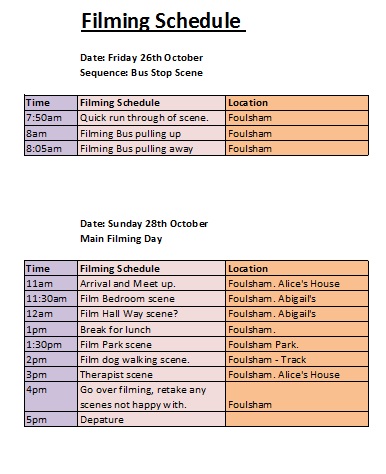
For all scenes (Except Therapist scence) Rose and Abigail are needed.
For Therapist scene - Jos and Abigail
Props by scene see: Props by Scene
Changes: Sunday 28th October has been changed to Sunday 4th November
Wednesday, 24 October 2012
Thriller Development #5: Characters & Cast
Characters
The Protagonist is a college student who is emotionally isolated from society. She enjoys her own company as she is socially dysfunctional. For years she has been followed/observed by a mysterious figure. It follows her everyday, but has never made contact with her, frightened her, or harmed her.
The Antagonist is the aforementioned figure. The figure is silent and wears a long, black coat, and a mask. It silently stalks the college student, and is never acknowledged - as though it's not even there. The Antagonist's presence adds to the eerie atmosphere.
The Therapist is interviewing the protagonist, asking them what happened (reminiscent of the archetypal psychological thriller). The therapist is presented as a clean and tidy workaholic, who is learning about the protagonist's dark past.
Cast
Therapist - Jos Banthorpe
Antagonist - Rose Denmark
Protagonist - Abigail Fish
The Protagonist is a college student who is emotionally isolated from society. She enjoys her own company as she is socially dysfunctional. For years she has been followed/observed by a mysterious figure. It follows her everyday, but has never made contact with her, frightened her, or harmed her.
The Antagonist is the aforementioned figure. The figure is silent and wears a long, black coat, and a mask. It silently stalks the college student, and is never acknowledged - as though it's not even there. The Antagonist's presence adds to the eerie atmosphere.
The Therapist is interviewing the protagonist, asking them what happened (reminiscent of the archetypal psychological thriller). The therapist is presented as a clean and tidy workaholic, who is learning about the protagonist's dark past.
Cast
Therapist - Jos Banthorpe
Antagonist - Rose Denmark
Protagonist - Abigail Fish
Casting Decisions:
 |
| Jos |
I asked Jos to play the Therapist because she is an adult. This would make our thriller more realistic then using a teenager as a therapist. She has acted before for projects back in 2010 when I helped out a university student with her media project. Jos acted in it also. Jos is part of the Foulsham Entertainers, who perform yearly variety/themed shows to raise money.
 |
| Abigail |
 |
| Rose |
Abigail is playing the protagonist because it is convenient for the bus scene (and other scenes that take place in the village). She was happy to do so and as a bonus made filming easier due to all the cast living in the same village.
Rose is playing the part of antagonist because the identity of the "figure" remains a mystery throughout, and so gender does not matter. Again, this is also convenient when filming scenes in the village. As my sister, she was happy to help out because her part was covered up and speechless.
Thriller Development #4: Location
Location Analysis:

Bus Stop, Dog Walking and Park scene: Location. Draw stick figures to represent where characters will be.
Therapist Room


Books and shelves indicate tidy professional. Planning to put in a desk and organise furniture around it too look like an office.
All but Walking/Lamppost scene have already been filmed. We changed our original decision to going to Abigail's house because it would of been a lot easier to do it all at mine. So we comprised and used similar settings.
We decided to use the school bus stop and filmed the school bus.
In each scene the Antagonist would stand silently in the distance or nearby the protagonist as they did daily/ordinary activities all basic everyday things.
The window scene downstairs - The scene where the bloody hand print hits the window and then it cuts to the title of the film. The thud we aim to have on the window should make people jump.
The window scene upstairs - When the protagonist opens the curtains and see the antagonist in the road. It will show that the antagonist is everywhere and the protagonist can't escape it, but also doesn't want it to go away because it doesn't bother them.
Dog Walking - The isolated path looks fairly dead with bits of colour. The antagonist just 'pops' up in between the hedge as the protagonist walks past - Creepy/Stalker
Walking/lamppost - The original plan was to film walking around the corner with the lamppost on but sadly the lamppost light didn't work so we comprised to using the desolate telephone box which has a light inside that flickers occasionally.
Bus Stop - The bus stop scene portrayed school life for the protagonist and shows how the antagonist is EVERYWHERE! This scene when filming was easy but you could only take one take a day due to the bus leaving for the high school
The locations are fairly isolated like in "No Country for Old Men", where there are people around but you never usually see them. The location is isolated but your not cut off from the world.
Tuesday, 23 October 2012
Thriller Development #3: Costume & Props
Costume:

Therapist - Red Lipstick, Red Nails, Tied up hair, Formal Clothing.
Why? - To be professional and bring colour to the opening. Almost to show her sanity in comparison to her patient.
Props by Scene:
Therapist Room:
Bus Stop:
Dog Walking:
--> Hall way
--> Bedroom
--> Park

Therapist - Red Lipstick, Red Nails, Tied up hair, Formal Clothing.
Why? - To be professional and bring colour to the opening. Almost to show her sanity in comparison to her patient.
Antagonist -We chose the black coat and to use a mask because we wanted the antagonist to have no identity. So no one can relate to him or see him as a human. We borrowed a V for Vendetta mask from another media student who isn't in our group. We wanted to have a black coat because its dark and black can be associated with evil and bad.
Protagonist - Wearing simple but dreary clothing. We decided on this because it wouldn't show her as anything special. Just a normal person who was slightly different.
Props by Scene:
Therapist Room:
- Desk
- Chair
- Lying down Chair
- Desk Lamp
- Folders and Papers
Bus Stop:
- School Bag
- School Bus - Richards Bus
- Other passengers
Dog Walking:
- A Dog (Rolo - Alice's Dog)
- Lead and Collar
- Coat (Cold weather)
--> Hall way
--> Bedroom
--> Park
Monday, 22 October 2012
How can I make my thriller appealing to my audience
(Joint Work with Abigail Fish)
Genre Research Statistics from 2010 - Secondary research
Genre:

In 2010 the highest grossing genre of film was Fantasy, followed by Science-fiction, Animation and then Romance. Thrillers were the ninth highest grossing films that year, averaging over £13,000 box office takings per site. The box office gross reached 19.3 million for thriller films in 2010. Fantasy was the highest grossing genre of film, because of the huge success of "Harry Potter and the Deathly Hallows Part 1". This shows that audiences are drawn to films which contain elements of fantasy, and also reaffirms the popularity of the Harry Potter series.

From the graph above we can see that the majority of independent films have a 15 certificate rating. 15 certificate independent films also grossed the highest. Approximately 56.6% of UK films have a rating of 12A. This is because, generally, 12A (family orientated) films appeal to a wider audience and therefore make more money.

The above table shows the highest ranking films/film genres in terms of gross box office. 20 thrillers were released in the UK in 2010, grossing at 19.3 million pounds. The thriller genre ranked 11th in the whole table (which contains 15 genres altogether), suggesting that either the genre has not been particularly popular recently, or perhaps that the films released under the thriller genre in 2010 were not as well-received as other films.
Audience Research statistics from 2010
From statistics in 2010, the average age group to attend the cinema was 15-34 years old. 30% were from the 15-24 age group and the other 20% were from the 25-34 age group. The lowest age group with 8% attending the cinema were 45-54 year olds. The increase in attendance from the 15-24 year old age group could be attributed to this age group socialising more, and going out more often. 18% of cinema goers are in the age group of 7-14 year olds. This is because young children need to be accompanied by an adult and don't tend to go alone or with friends, especially at the ages 7-13.
Gender Audience Research:
61% of cinema goers who went at least once a year were male and 62% were female. More males go to the cinema at least once a month than females, and an average of 19% overall go to the cinema at least once a month.

The tables above show which films released in 2010 had a predominantly female or male audience. The third table shows the films for which audience gender was not significant. More females seem to have attended 'girly' films which involve romance. Where as males attended films which contained action, violence and a bit of comedy.

It is a surprise to see that 80% of people watch films on TV then owning them on DVD. 4% go to the cinema which is once again very surprising but the prices are probably a deterrent especially due to the current economic climate.
One of the top thriller films is The Ghost in 2010 with 12 releases and 8.33% total box office, ranked 5th in UK Independent films.
Thriller needs to:
Appeal to both genders
Invite Thriller lovers
Action, Fantasy and Romance = Wide audience range
Appeal to both genders
Invite Thriller lovers
Action, Fantasy and Romance = Wide audience range
Rotten Tomatoes (Own research)

The Dark Knight Rises received a positive reception. This is due to the 3rd of a trilogy and of course batman fans will want to see it. Batman does appeal to more males in general and the once again basic plot line (stereotypical superhero) which could be the cause to why the percentage on the "tomatometer" is lower than for Looper. The target audience rules out females with some exceptions due. I think the focus is of Batman being well known and it being the 3rd in a trilogy makes the film more of a "big deal" than other thrillers.


Looper has the highest meter rating due to a better plot line than Batman. The comments by critics are positive and gives you all the good points about the film. Less audience liked it, maybe due to the genre and the gender clash. More males maybe liked it, like in Batman which lowered the audience.
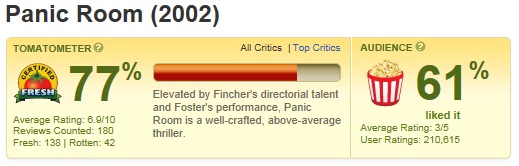

The ratings aren't as high but this could be caused by the plot line of characters. It focuses around a teenage girl which would lower the appeal for males. Even though some people are in denial, more of a male cast is more successful. The plot line also is predictable which would lower the reviews.
Wednesday, 17 October 2012
Thriller Development #2: Synopsis
Opening Sequence
We see
brief snippets of the daily routine of the protagonist: getting up and opening
the curtains in the morning, leaving the house to catch the bus, the bus journey
to work/college, walking the dog. During each snippet of each part of the
routine, we see a figure in the background, apparently watching the protagonist.
The figure is never seen clearly, and is stood off-centre in each shot. The
music is quiet, eerie, and ambient. The shots of the daily routine are inter cut
with shots of the protagonist talking to a therapist, in a small office. The
protagonist explains that for some time they have been watched. They never
felt threatened, or scared – just that they were being observed. We then see a
shot of the protagonist’s front door. Through the frosted glass of the front
door, we see the blurred silhouette of the antagonist. They raise a hand, and
scrawl a message on the glass backwards. They rest their hand on the glass, and
the sequence ends.
1 - Inside therapist's office. Protagonist begins to talk.
2 - Protagonist continues into voice-over. Shot of them opening bedroom curtains. Antagonist is seen in the street outside, under a street lamp.
3 - Tracking shot of protagonist walking down the road, to bus stop.
4 - Shot of protagonist at bus stop, then boarding bus, and bus leaving.
5 - Shot from protagonist's P.O.V. looking out of bus window. Antagonist is seen in the distance.
6 - Protagonist leaving college/work, antagonist lurking behind them/in the background.
7 - Protagonist leaving house, walking dog in woods. Antagonist seems closer.
8 - Shot of protagonist's hallway and front door. Antagonist stood behind door. Camera zooms in slowly/tracks toward the door, as the antagonist writes a message on the glass. Antagonist rests hand on glass, leaves bloody handprint. Sequence ends.
Possible Titles
"Creep"
"Quietus"
"Delirium"
Final Title Choice "Hysteria" We chose this title because of the connotations of the word. The two possible definitions of the word are
(1) an uncontrollable outburst of emotion or fear, often characterized by irrationality, laughter or weeping,
and (2) a psycho-neurotic disorder characterized by violent emotional outbreaks, disturbances of sensory and motor functions and various other abnormal effects.
If a person is hysterical, we define them as being emotionally unstable, and possibly physically violent - a danger to themselves and to others. Although the beginning of our opening presents the antagonist as being calm, and not particularly intimidating, in the very last shot we see the antagonist suddenly as being extremely threatening. This sudden change reflects the sudden, violent outburst that the title alludes to. Even the protagonist is represented as someone who is undergoing therapy - clearly they too have a fragile mental state, in need of repair.
(Taken from Abigail's blog and I contributed with evaluating why we chose Hysteria as the same of our Thriller)
Subscribe to:
Posts (Atom)